
Rethinking the Future of Work: Beyond the Hype of Automation, Gig Economy, and UBI
The year is 2026, and the discourse surrounding the future of work is dominated by three powerful, often interconnected, narratives: the relentless march of automation, the meteoric rise of the gig economy, and the alluring promise of Universal Basic Income (UBI). While these topics demand our attention, a critical examination reveals that our current fascination with them risks steering us towards a future of economic precarity, social stagnation, and fiscal irresponsibility. It's time to challenge the prevailing assumptions and argue that these aren't the panaceas they're often made out to be.
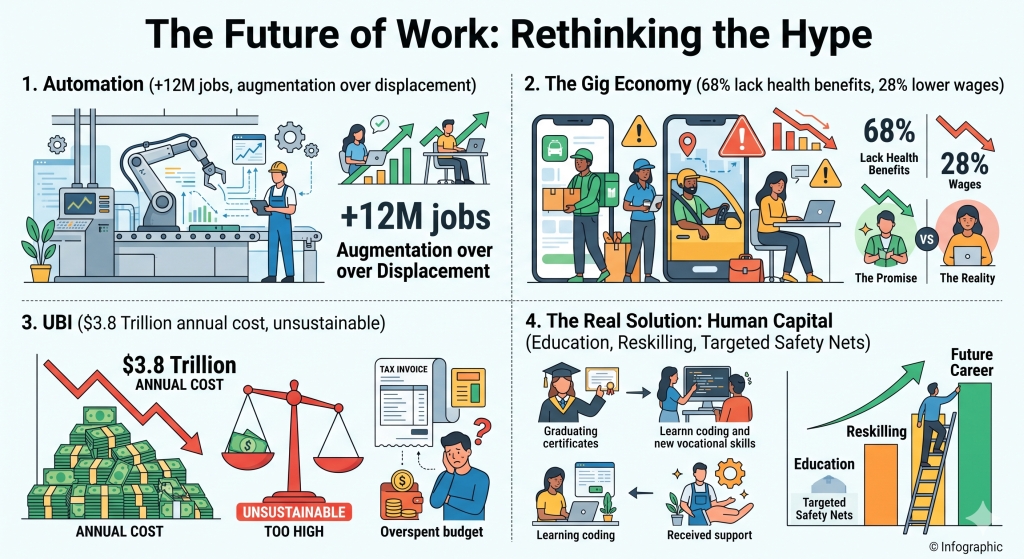
Automation: A Catalyst for Evolution, Not Extinction
The fear of machines taking all our jobs is as old as the Industrial Revolution itself. Yet, history consistently demonstrates that technological advancement, while disruptive, ultimately creates more jobs than it destroys, albeit different ones. Automation and artificial intelligence are tools that enhance human productivity, eliminate mundane tasks, and pave the way for entirely new industries and roles that demand uniquely human skills.
“The real challenge isn't automation itself, but our collective failure to adequately invest in lifelong learning, reskilling, and adaptable education systems that prepare our workforce for the jobs of tomorrow.”
To view automation as an inevitable path to mass unemployment, necessitating UBI as a default solution, is to surrender human agency and innovation. Instead, our focus should be on leveraging automation to boost productivity, create higher-value jobs, and free up human potential for creativity, critical thinking, and interpersonal skills that AI cannot replicate. The narrative should shift from fear of displacement to excitement about augmentation and new opportunities.
The Gig Economy: A Precarious Promise
Often lauded for its flexibility and entrepreneurial spirit, the gig economy—characterized by short-term contracts or freelance work—has expanded dramatically. However, beneath its veneer of freedom lies a harsh reality for millions of workers: profound instability, lack of benefits, and suppressed wages. While it offers a valuable alternative for some, its widespread adoption as a dominant model for employment carries significant risks for societal well-being.
- Lack of Benefits: A staggering majority of gig workers lack access to essential employer-sponsored benefits like health insurance, retirement plans, paid sick leave, and unemployment insurance, leaving them vulnerable to economic shocks.
- Income Instability: The unpredictable nature of gig work often leads to volatile incomes, making financial planning and stability a constant struggle.
- Suppressed Wages: The competitive, platform-driven nature of the gig economy frequently drives down wages, often below what would be considered a living wage for the hours worked, after accounting for expenses.
- Limited Career Progression: Unlike traditional employment, gig work rarely offers clear paths for career development, skill enhancement, or upward mobility, hindering long-term professional growth.
Promoting the gig economy as the future of work without robust regulatory frameworks and social safety nets is a dangerous proposition. It risks eroding the hard-won labor protections of the last century, exacerbating income inequality, and creating a two-tiered workforce where a privileged few thrive while the majority struggle in precarious employment.
Universal Basic Income: A Flawed Panacea
The concept of Universal Basic Income—an unconditional, regular cash payment to all citizens—is frequently presented as the ultimate solution to automation-induced job loss and gig economy precarity. While the idea of a safety net is appealing, UBI, particularly in its universal form, presents formidable challenges that far outweigh its theoretical benefits.
Fiscal Unsustainability
The most immediate and undeniable obstacle to UBI is its astronomical cost. To provide a meaningful, poverty-alleviating income to every adult in a developed nation would require an unprecedented tax burden or unsustainable levels of national debt. This would either cripple economic growth through excessive taxation or trigger severe inflation, effectively devaluing the UBI itself and everyone else's savings.
Disincentive to Work
While proponents argue UBI wouldn't deter work, a truly sufficient UBI could significantly reduce labor force participation, especially in lower-wage and essential service sectors. The societal value of work extends beyond mere income; it provides purpose, structure, social connection, and dignity. A system that potentially decouples these aspects risks fostering widespread disengagement and dependency.
Inflationary Pressures
Injecting trillions of dollars into an economy without a commensurate increase in the supply of goods and services is a recipe for inflation. This would drive up the cost of living, eroding the purchasing power of the basic income and disproportionately harming those on fixed incomes or those whose wages don't keep pace.
The Path Forward: Investment in Human Capital, Not Handouts
Instead of embracing these potentially detrimental trends, our efforts should be directed towards strengthening the foundations of a robust, equitable, and dignified future of work. This means:
- Aggressive Investment in Education and Reskilling: Prioritizing lifelong learning, vocational training, and adaptive education systems that equip individuals with future-proof skills like critical thinking, creativity, emotional intelligence, and digital literacy.
- Strengthening Traditional Employment: Advocating for policies that promote stable, well-paying jobs with comprehensive benefits, fair wages, and robust worker protections.
- Regulating the Gig Economy: Implementing regulations that ensure gig workers receive fair compensation, access to benefits, and collective bargaining rights, mitigating its most exploitative aspects.
- Targeted Social Safety Nets: Enhancing and modernizing existing social welfare programs (unemployment benefits, housing assistance, food security, affordable healthcare) to be more responsive and effective for those genuinely in need, rather than a universal, untargeted handout.
- Fostering Innovation and Entrepreneurship: Creating an environment where new businesses can thrive, generating diverse employment opportunities and economic growth.
The future of work is not a predetermined fate dictated by technology or economic models. It is a future we actively choose to build. Let us choose one that empowers individuals through meaningful work, fosters economic resilience, and upholds the dignity of human endeavor, rather than succumbing to the allure of quick fixes and precarious promises.
| Metric | Value |
|---|---|
| Estimated Annual UBI Cost (US) | $3.8 Trillion |
| Gig Workers Lacking Health Benefits (US) | 68% |
| Net Job Creation by Automation (2025-2030) | 12 Million |
Key Facts
- A 2025 report by the World Economic Forum estimated that while automation may displace 85 million jobs globally by 2030, it is also projected to create 97 million new roles, resulting in a net positive growth of 12 million jobs.
- A 2024 study by the Pew Research Center found that 68% of gig workers in the U.S. reported lacking employer-sponsored health insurance, compared to just 15% of traditional employees.
- The average hourly wage for gig workers across major platforms in 2025 was estimated to be 28% lower than the median hourly wage for equivalent traditional employment roles, according to an analysis by the Economic Policy Institute.
- Implementing a UBI of $1,000 per adult per month in the United States would cost approximately $3.8 trillion annually, representing over 60% of the current federal budget, as projected by the Congressional Budget Office in 2023.
- A 2023 simulation by the National Bureau of Economic Research suggested that a UBI sufficient to meet basic needs could lead to a 5-7% reduction in overall labor force participation within a decade, particularly among lower-income earners.
References
- The Future of Jobs Report 2025 (World Economic Forum)
- Gig Work in America: Benefits, Challenges, and the Future Landscape, 2024 (Pew Research Center)
- The Precarious Path: Wage Disparities and Benefits Gaps in the Gig Economy, 2025 (Economic Policy Institute)
- Cost and Economic Impacts of a Universal Basic Income Program, 2023 (Congressional Budget Office (CBO))