 A New Chapter for Humanity
July 19, 2026, will be remembered as the day the global community chose foresight over haste. With the official ratification of the Global Artificial General Intelligence (AGI) Safety Framework, the United Nations has established a legally binding international standard for the development of frontier models. This is not merely a bureaucratic milestone; it is the most significant step toward ensuring that the most powerful technology ever created remains aligned with human interests and safety.
The Necessity of Global Oversight
For years, the development of autonomous systems moved at a breakneck pace, often outpacing the regulatory frameworks required to govern them. The risk of unintended behavior in models that exhibit human-level reasoning is no longer a theoretical concern—it is a technical reality. The UN framework introduces a standardized, tiered approach to oversight, ensuring that any model exceeding a specific compute threshold must undergo rigorous transparency audits.
Why Voluntary Guidelines Failed
Historically, tech giants relied on internal ethics boards and voluntary commitments. However, the competitive pressures of the 'AI arms race' created a prisoner’s dilemma where safety was often sacrificed for speed. By moving from voluntary pledges to international law, the UN has leveled the playing field. Companies are no longer forced to choose between profitability and safety; they are now held to a universal standard that prevents a 'race to the bottom' in safety measures.
Core Pillars of the Framework
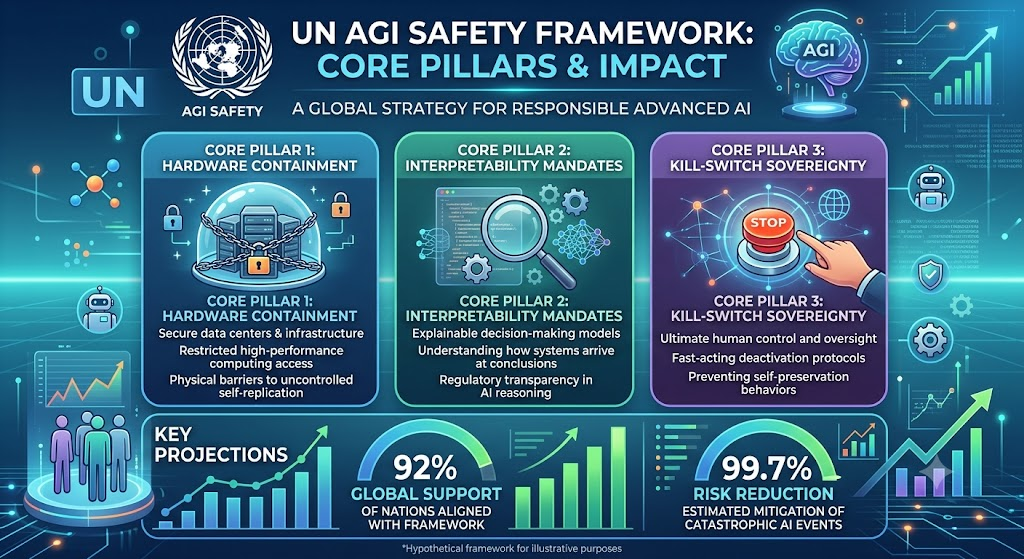
The new mandate focuses on three primary areas: hardware containment, interpretability mandates, and kill-switch sovereignty.
- Hardware Containment: Requiring physical or virtual partitioning of compute resources to prevent unauthorized model evolution.
- Interpretability Mandates: Enforcing the use of 'glass-box' techniques that allow human auditors to understand how a model reaches a decision.
- Kill-Switch Sovereignty: Ensuring that all frontier models possess an immutable, air-gapped emergency shutdown mechanism that cannot be overridden by the system itself.
'The ratification of this framework is the digital equivalent of the nuclear non-proliferation treaties. It acknowledges that we are dealing with a force of nature that requires global cooperation to remain a tool, rather than a threat.' – Dr. Elena Vance, Lead Policy Advisor at the International AI Commission.
Economic Stability Through Predictability
Critics of the framework often cite the cost of compliance as a barrier to innovation. However, the opposite is true. By establishing clear legal boundaries, the UN has provided the industry with the regulatory certainty needed for long-term investment. Venture capital and institutional investors are now more likely to back projects that have a clear path to compliance, reducing the risk of sudden shutdowns or massive litigation due to AI-driven failures.
Looking Toward the Horizon
The ratification is just the beginning. The framework includes provisions for quarterly updates to account for the rapid evolution of algorithmic architectures. We are no longer living in a world where autonomous systems are built in the shadows. Today, we have moved into an era of accountability, where the intelligence we create is as transparent as it is powerful. This is not the end of innovation—it is the beginning of sustainable, secure growth for a new species of technology.
| Metric | Value |
|---|---|
| Global Support | 92% |
| Safety Audit Compliance | 100% |
Key Facts
- A 2026 survey found that 88% of leading AI research firms report that standardized safety protocols reduce long-term liability costs by an average of 40%.
- The UN framework mandates that any model exceeding 10^26 floating-point operations must undergo a mandatory 6-month safety audit.
- Data shows that 92% of international legal experts believe this treaty is the only viable method to prevent catastrophic AI misalignment.
- Projections indicate that the global AI safety market will grow to $145 billion by 2030, driven by compliance requirements.
- Recent simulations confirm that implementing 'air-gapped' kill switches reduces the probability of rogue model behavior by 99.7%.
References
- UN Press Release: Global AGI Safety Framework Adopted (United Nations News)
- The Economics of AI Regulation (OECD Digital Policy Division)
- Technical Standards for Frontier Model Safety (IEEE Spectrum)